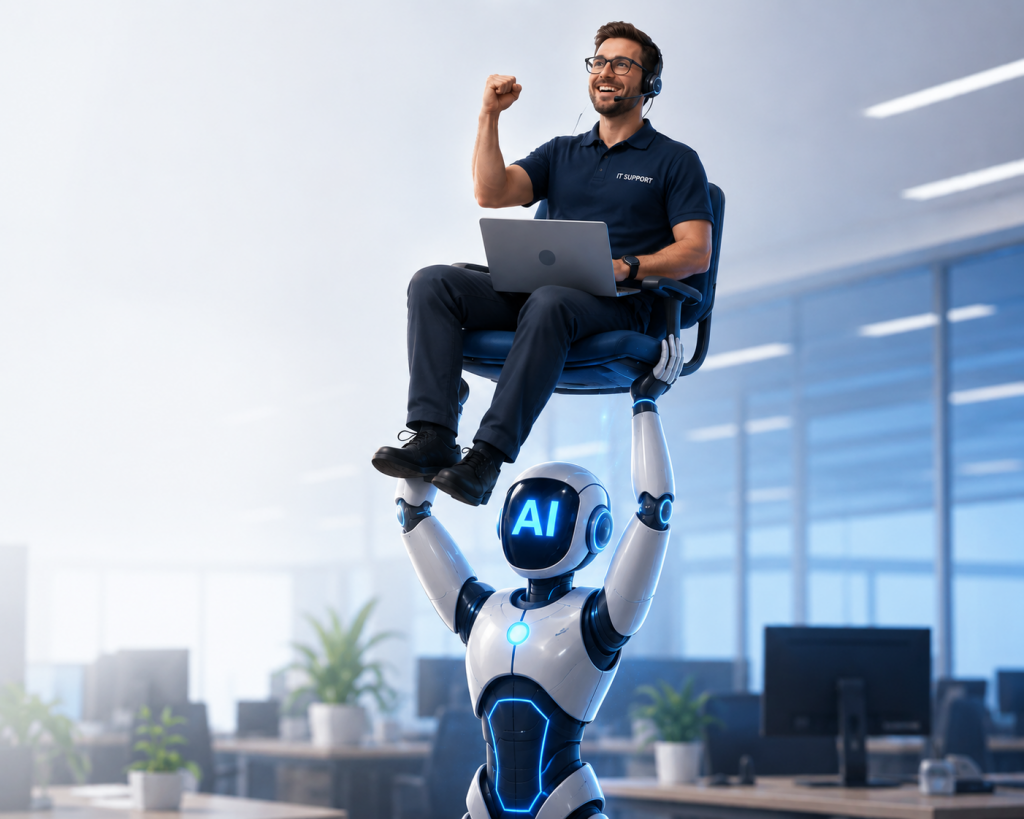
How Can AI Transform the IT Support Desk?
In today’s IT operations, the Support Desk is no longer just a ticket‑taking function — it’s the front line of service quality, user experience, and operational stability. As organizations mature their ITIL practices, one question keeps surfacing: How can AI enhance the precision, speed, and consistency of our escalation processes?
The answer is: AI doesn’t replace the ITIL framework — it reinforces it. It brings discipline to functional escalation, clarity to hierarchical escalation, and intelligence to every decision point in between.
- AI Improves Functional Escalation by Reducing Misroutes and Classification Errors
Functional escalation depends on accurate triage. But in most environments, misclassification is one of the biggest sources of SLA breaches.
AI strengthens this layer by:
- Auto‑classifying tickets based on historical patterns, CI data, and user context
- Detecting anomalies that indicate a ticket belongs to a specialized resolver group
- Identifying repeat incidents tied to the same asset, service, or user group
- Recommending the correct assignment group with confidence scoring
- Flagging potential P1/P2 incidents before they escalate organically
This reduces the “ping‑pong effect” between teams and ensures that work lands with the right resolver group the first time.
Outcome: Faster time to resolution, fewer SLA breaches, and a cleaner operational flow.
- AI Enhances Hierarchical Escalation with Real‑Time Risk Awareness
Hierarchical escalation is about visibility, governance, and decision‑making. AI strengthens this by:
- Monitoring SLA clocks and predicting when a breach is likely
- Alerting leadership when a ticket or incident shows signs of stalling
- Identifying systemic issues that require managerial intervention
- Providing real‑time dashboards that highlight workload imbalances
- Surfacing patterns that indicate training gaps or process breakdowns
Instead of reacting to escalations after they occur, AI enables a proactive posture — leadership sees the risk before the breach, not after.
Outcome: Leaders intervene earlier, escalations become intentional rather than reactive, and service quality becomes more predictable.
- AI Strengthens Knowledge Management — the Backbone of ITIL
Knowledge is the fuel that powers both functional and hierarchical escalation.
AI elevates knowledge management by:
- Suggesting relevant KB articles during ticket creation and triage
- Identifying missing or outdated documentation based on ticket patterns
- Auto‑drafting knowledge articles from resolved incidents
- Analyzing FCR and deflection rates to improve self‑service
This creates a virtuous cycle: better knowledge → fewer escalations → more time for strategic work.
- AI Enables Predictive Operations Across the Entire Support Desk
Beyond escalation, AI helps IT leaders shift from reactive firefighting to proactive service management:
- Predicting ticket surges based on seasonality or business events
- Identifying failing assets before they generate incidents
- Highlighting technicians who may be overloaded
- Recommending staffing adjustments based on demand patterns
- Detecting changes that correlate with increased incident volume
This is where AI becomes a force multiplier — not just solving today’s problems, but preventing tomorrow’s.
- AI Supports a More Mature, Data‑Driven ITIL Practice
The real value is strategic:
- Cleaner operational data for continual improvement
- More consistent adherence to ITIL processes
- Better alignment between teams through intelligent routing
- Improved user satisfaction through faster, more accurate support
- Reduced operational cost through automation and deflection
